AI OmniCore
The AI OmniCore is the compute engine at the heart of the Omni Processing Unit. It runs any AI/ML model across training, fine-tuning, and inference. Flexible matrix shapes, multiple contexts per core, and hardware-managed resource arbitration keep utilization high, while confidential compute and virtualization are built into the core itself.
Rethinking the AI core
Efficient AI cores with hardware-managed scheduling deliver what GPU architectures cannot.

Run any model, any phase
One core architecture covers training, fine-tuning, and inference, from small models to frontier scale.

Utilization by design
Run multiple models, contexts and agents per core with instant kernel launches keep compute busy, not waiting.

Secure by architecture
Memory encryption, confidential compute, and virtualization are native to the core, not bolted on.
The AI OmniCore
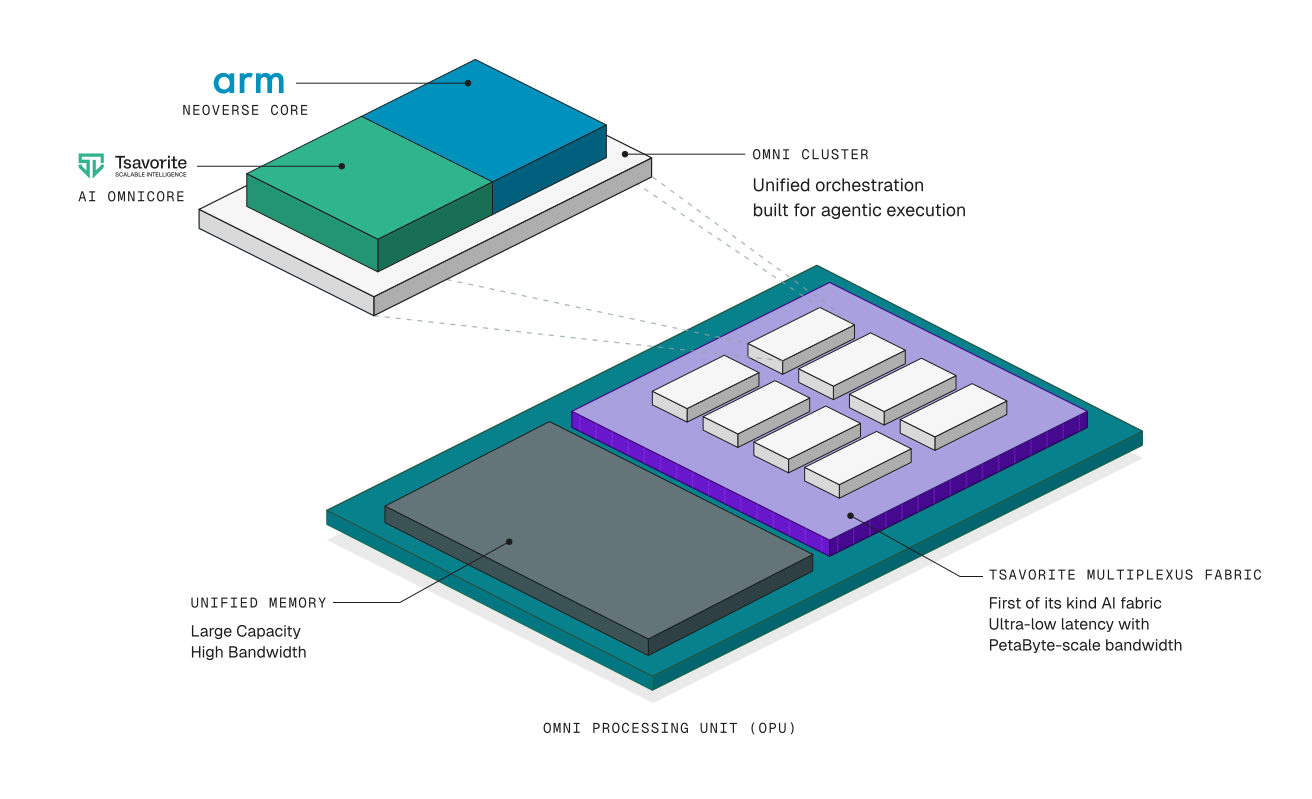
The compute engine of the OPU: Closely couple AI Omnicores paired with Arm Neoverse cores, running any AI/ML model with built-in security and hardware-managed scheduling.
Big cores delivering big advantages
The AI OmniCore takes a different path from GPUs: With a simplified ISA, hardware-guaranteed coherency, and no stream synchronization. The result is higher efficiency, better utilization, and easier programming.
Flexible execution model
OmniCores run multiple program, multiple data workloads in addition to SIMD, with multiple contexts per core and flexible matrix shapes. Kernels launch and evict instantly, and hardware-managed resource arbitration schedules work without software overhead, keeping latency ultra-low and predictable.
Memory built for AI
Gigabyte-scale local caches and a unified memory hierarchy keep weights and activations close to compute, while memory encryption protects data in use. Direct interfaces support scale-up and scale-out, linking OmniCores through the MultiPlexus fabric with ultra-low latency and PetaByte-scale bandwidth.
Every precision, automatically
All Nvidia data types are supported with automatic quantization, from 4-bit NVFP4, MXFP4, and INT4 through FP8, BF16, FP16, TF32, and FP32, with support for multiple lengthy 1K vectors. Quantization is similar to leading GPUs, for a uniform experience across models.
A different core, built for AI agents
Native FP-formats
from 4-bit to 32-bit
GB-scale
local caches
Zero
data copies
FAQs
Common questions about the AI OmniCore, its architecture, and how it compares to GPU-based compute.
What is the AI OmniCore?
The AI OmniCore is the compute engine inside the Omni Processing Unit. OmniCores are grouped into Omni Clusters and paired with Arm Neoverse cores for unified orchestration built for agentic execution, connected by the MultiPlexus fabric over unified memory. A single core architecture runs any AI/ML model across training, fine-tuning, and inference.
How is it different from a GPU?
Instead of thousands of small cores, the OmniCore architecture uses larger cores with a simplified ISA and less control overhead. It runs multiple program, multiple data workloads in addition to SIMD, with hardware-guaranteed coherency and no stream synchronization. It also does things GPUs cannot: gigabyte-scale local caches, memory encryption, hardware-managed resource arbitration, and instantaneous kernel launch and eviction, all with easy programmability.
What precisions and data types are supported?
All Nvidia data types are supported with automatic quantization. AI OmniCores handle 4-bit formats such as NVFP4, MXFP4, FP4, and INT4, 6-bit MXFP6, 8-bit MXFP8, FP8, FLOAT8, MXINT8, and INT8, 16-bit BF16 and FP16, and 32-bit TF32 and FP32, plus multiple 1024-bit vectors. Quantization quality is similar to or better than Nvidia, so models behave the way users expect.
How does it keep workloads secure?
Security is built into the core rather than layered on top. Memory encryption protects data in use, and confidential compute and virtualization are native capabilities, enabling isolated, multi-tenant operation. Combined with platform-level features such as secure boot and trusted execution in TAOS, this supports regulated and IP-sensitive deployments.
How does it scale to larger systems?
OmniCores expose direct interfaces for both scale-up and scale-out. Within the OPU, Omni Clusters connect through the MultiPlexus fabric, a first-of-its-kind AI fabric with ultra-low latency and PetaByte-scale bandwidth over large, high-bandwidth unified memory. Across systems, the same fabric links OPUs into one coherent compute domain, so the architecture spans palm-sized devices to full racks.
Related insights
Our architecture provides unmatched computational efficiency, allowing intricate AI models to operate with low latency and high throughput.
Beyond GPUs: why we built Tsavorite
Our view is that AI has outgrown the way the industry builds computers for it. Adding more of the same hardware is no longer the answer. AI needs an architecture designed for it from the start, one that becomes more efficient as it grows rather than less.

Tsavorite Scalable Intelligence Sets New Frontier for AI Efficiency and Scale with the Omni Processing Unit
See the OmniCores in action
Talk to us about evaluation systems, benchmarks, and how the OPU runs your models with no code changes.
Talk to our team