Private AI from desk to rack: introducing Helix
By Chandra Joshi, Chief Product Officer
AI is moving out of the cloud and into the places where data lives and decisions happen: robots and machines, enterprise systems, and private datacenters. Helix is our family of systems built for that shift.
There are three form factors, Helix-M, Helix-D, and Helix-R, and one architecture behind them. Each is powered by the Omni Processing Unit and runs the same TAOS software.
Why AI is moving closer to the data
Frontier models will keep being trained in large cloud datacenters. Much of the work AI does once deployed, however, happens next to the data: agents reading internal documents and calling tools, or physical AI controlling a machine in real time.
Three pressures pull that work on-premises. Some data cannot leave the building, some decisions cannot wait on a network round trip, and long-running agents need costs that stay predictable as usage grows.
We see AI settling into two planes: frontier intelligence in the cloud, and a distributed execution plane where agents and machines do their work privately and locally. Helix is built for the second.
Helix-M: private AI at the edge
Helix-M is a compact, high-performance AI system that delivers private, low-latency, petaFLOP-scale intelligence for secure multimodal workflows. It brings datacenter-class AI to robotics, automation, and real-time decision-making.
With unified memory and ultra-low latency, Helix-M runs large models locally, without cloud dependence or the overhead of moving data. With 96GB of memory and 1PFLOPS performance, it runs 100B+ parameter models.
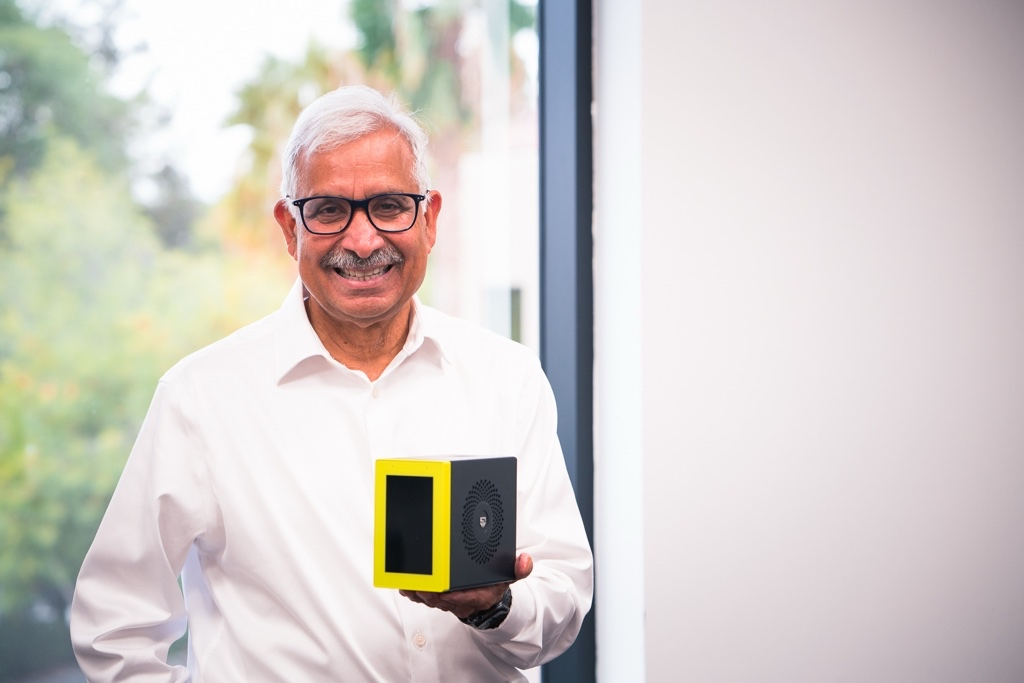
That’s the Helix-M system in the palm of my hand
Helix-D: datacenter-grade AI on a desk
Helix-D is a desktop-class system powered by one or more OPUs. It gives a team datacenter-grade performance for private, end-to-end AI workflows without a datacenter build-out.
Helix-D is also stackable. Up to four units connect into a single unit of AI compute, with eight OPUs and 768 GB of unified memory. The model sees that memory as one pool, so a stack runs models too large for any one box, including frontier-scale open models with hundreds of billions of parameters, such as DeepSeek-V4.1-Flash or Muse Spark Open. A team can start with one Helix-D and add units as its models grow, with no rack, no datacenter, and no change to its software.
In addition, it is also possible to locally fine-tune a model on a Helix-D, which eliminates the need for exposing confidential/private data to an external cloud or service provider.
Helix-R: from edge clusters to exascale
Helix-R is a rack-mountable OPU platform that scales from edge clusters to exascale deployments by unifying multiple systems. MultiPlexus joins nodes into one coherent compute domain with unified memory, so a cluster behaves like one large machine.
Helix-R is also air-cooled and fits the power envelope of a standard rack, so it deploys in existing datacenters without liquid cooling or facility changes. A single node runs trillion parameter models and nodes combine to serve multi-trillion parameter frontier models, all with industry-leading tokens per second per watt.
One architecture, three form factors
Every Helix system runs the same OPU architecture and the same TAOS software. A model or agent built on one runs on the others, so customers choose a form factor by where the work needs to run, and their software comes with them.
We’re now accepting pre-orders for Helix systems. Get in touch to learn more about availability and discuss which system would best suit your needs.